
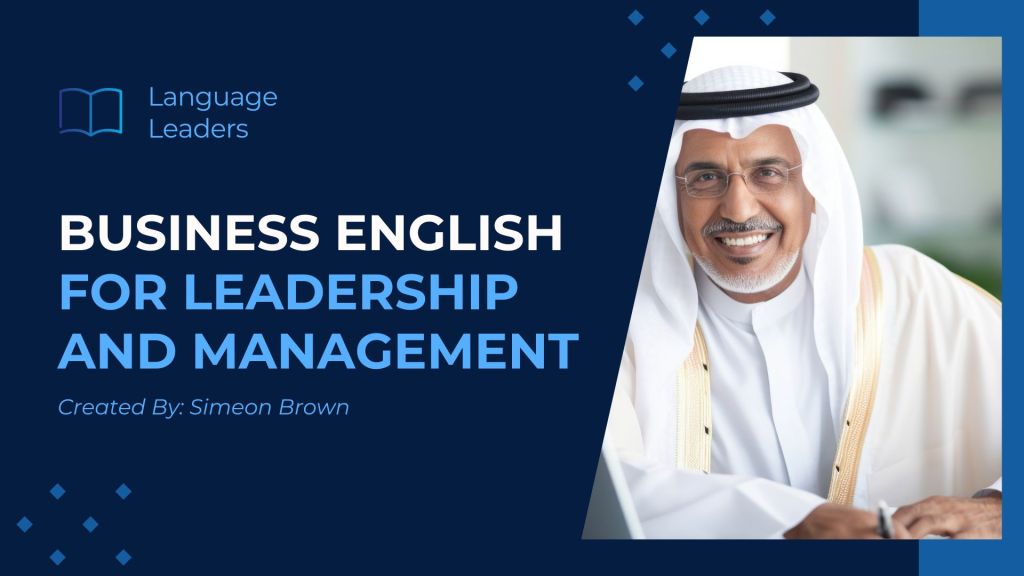
In today’s fast-paced and globalized business world, mastering Business English is essential for anyone in leadership or management roles. As industries continue to evolve, particularly with the rise of digital transformation in regions like Saudi Arabia, professionals must communicate effectively in English to lead diverse teams and oversee complex projects. Whether you’re a software engineer in Riyadh or an IT manager working on remote work initiatives, clear and effective communication is key to ensuring success.
Introducing the Business English for Leadership and Management Course
In my “Business English for Leadership and Management” course, we focus on the skills that matter most to professionals. For example, understanding how to write clear technical documentation is critical when leading teams in the tech industry. At the same time, improving your ability to communicate in situations like project management meetings or when discussing mistakes in CV writing with potential hires is vital.
Language Leaders is the only company that offers specialized Business English for Tech courses focusing on the Riyadh region. Currently we serve around 50 students, so course availability is limited, but you are recommended to send an email or book a free trial class if you’re serious about advancing your international opportunities in your tech career.
Develop Communication and Language Skills
One student turned to Simeon when he had the chance to receive a promotion to Technical Solution Senior Manager at a large international technology company. “My promotion was dependent on passing the ITEP Business exam to show I had the English skills needed for the work environment. Simeon’s class gave me the language skills I needed to pass the test and receive the promotion.”
Through this course, you’ll also develop your communication skills, enhancing your ability to engage with clients, manage remote teams, and work across borders. This is more than just language learning; it’s about preparing for leadership in a digital, global workplace.
If you’re curious about my course, here I will give you a complete outline and short description of the topics covered. If you would like to join me for a free trial class, just send me a DM.
Course Overview
Unit 1 – Knowing Your Leadership Style
Practice using adjectives clauses to give opinions and feelings as you decide what leadership style you would use to manage a team and discuss the leadership style of Bill Gates. Discuss the three main leadership styles: authoritarian, participative and delegate.
Unit 2 – Building Your Staff
Practice using comparative structures to discuss resumes and CVs and talk about staffing decisions. Learn specific prepositions that accompany common vocabulary related to the topic as you practice filling a position. Discuss the steps to fill a position, and learn the difference between a resume and a CV.
Unit 3 – Motivating Your Team
Use conjunctions “because”, “since” and “as” to discuss positive, negative, internal and external motivations in the context of a managing a project that is behind schedule. Learn how to inspire an unmotivated employee as we discuss what motivates you.
Unit 4 – Resolving Conflict
Learn to use the imaginary past to resolve a conflict at work between two employees. Learn some idioms often used to talk about conflict in the workplace, and practice which specific prepositions should follow certain words.
Unit 5 – Project Management
Practice the future continuous to explain a project timeline and plan a project. Discuss the five stages of project management: defining, planning, creating, checking and closing, and learn common collocations related to stages, resources and timelines.
Unit 6 – Delegating
Use polite expressions to delegate a to-do list to various employees and include your expectations for each task. Additionally, learn some collocations related to expectations. Discuss the benefits of delegating and tips for delegating effectively.
Unit 7 – Giving Feedback
Learn useful phrases to give constructive criticism on employee performance in a performance review. Learn the dos and don’ts of giving feedback, and talk about the difference between direct and indirect communication.
Unit 8 – Managing Change
Practice paired conjunctions to discuss the positive and negative impacts of change and deal with change resistance as you practice announcing a new change to your employees. Learn the difference between verb and noun forms of commonly used vocabulary.
Unit 9 – Problem Solving
Use the second conditional to give advice to address problems. Learn useful problem solving questions to identify and analyze the problem and come up with and implement solutions. Discuss inspirational quotes from Duke Ellington and Albert Einstein.
Unit 10 – Virtual Leadership
Learn “be going to” and “will” to predict the future of working remotely, discuss the dos and don’ts of virtual meetings, and talk about virtual challenges. Additionally, learn to describe data of infographics related to working from home.
Unit 11 – Company Culture
Practice complex conjunctions for cause and effect to design and describe your own company culture by analyzing the examples of Google, X and Spotify. Learn common collocations to describe values, satisfaction and expectations, and discuss the four main styles of company culture: clan, adhocracy, market, and hierarchy.
Unit 12 – Cross-Cultural Management
Use business idioms to give advice to a new employee, talk about cultural differences and communication styles. Use new vocabulary to talk about taboos and norms in your culture and discuss some common characteristics of American business culture as you practice welcoming a new employee to your company.
Growing Software Engineer Management Careers
One student found the last unit specifically helpful. She is a Software Apps Engineering Senior Manager for a well known web services provider, and frequently finds herself navigating the cultural differences between her American colleagues based in California and the expectations and communication styles of her home culture. “Simeon gave me useful insights into why my American coworkers act the way they do and what to expect from them.”
Simeon Brown leads the course. He has taught in Arabia since 2013 and began Language Leaders in 2018 to better serve Saudi tech professionals. With a true love and connection to Saudi culture, he brings his unique teaching style, using techniques such as task based learning and neurolanguage coaching. His motto is “Education gives people skills, and skills give people opportunities.” Simeon is from Wisconsin, USA and has received degrees from Arizona State University as well as UIC Barcelona.
An Essential Course for IT Professional Training
The “Business English for Leadership and Management” course is designed to equip you with the tools you need to succeed in today’s dynamic workplace. As global collaboration and AI tools continue to shape industries, strong language skills will empower you to leverage new technologies and effectively guide your team. This course can help you avoid common language mistakes in the work environment and should be an essential part of IT professional training.
 Simeon Brown